
|
The journal riff-raff
|
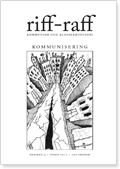
| spring 2011 |
| 302 pp. 100 SEK order |
|
|
No. 9: Communisation
This issue is about the communist revolution of today: communisation, the process in which the proletariat abolishes its own conditions of existence, i.e. all that which determines the proletariat as a class: property, exchange, work, the State, etc. The issue is divided into four parts. In the first one we discuss communisation as a revolutionary perspective today, as well as the origins of the concept. The second part is devoted to Marcel and the journal Dissident and their particular view of communisation. In the third part we try to get a grip on history and examine more closely the revolutionary movements of the past. The fourth and last part consists of a text which examines capitals restructuring in detail a number of transformations which together laid the foundation of a new relation between the classes and thus of a new revolutionary perspective.
|

|
|
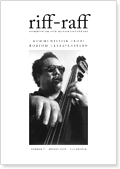
| autumn 2006 |
| 442 pp. 130 SEK order |
|
|
No. 8: Communist Theory Beyond the Ultra-Left
The main part of this issue is dedicated to a presentation of the group Théorie communiste and their attempt to, with the help of a periodisation of and with the magnifying glass next to capital and the class struggle, try to understand the content and meaning of the historically past cycles of struggles as well as the current situation. As usual, we look at what a proletarian revolution has to be today, what openings to communism that can emerge as a response to the exploitation by capital. In connection to this, we come in contact with the ‘communising current’ – what is it and what does it want? In a second part follows a debate around Marcel’s text from the last issue and a discussion on the crisis–collapse problematic. The last part make up the Marx–Engels series in which we this time is coming with fresh Swedish translations of two letters by Marx and a selection from The holy family.
|
|
| summer 2005 |
| 218 pp. 70 SEK order |
|
|
No. 7: Critique of Political Organisation
In our seventh issue we criticize and discuss the political organization from different perspectives, as the welfare-state, democracy and activism. In connection to this, in an essay, Marcel from the editorial board stresses the importance of the de-subjecification of the proletariat, i.e. its abolishment as class. As a continuation of the discussion on the theories of decadence and crisis, we present an article by the Italian Giacomo Marramao where he enthrones the question of method in the treatment of the subject–object-relation in defence of, among others, Grossman and Mattick. Finally, in his “King of Prussia”, Marx emphasizes the social character of the revolution and maintains that its political side chiefly is dissolving.
|
|
| summer 2004 |
| 164 pp. 60 SEK order |
|
|
No. 6: The Theory of Decline or the Decline of Theory?
In this issue, a series of articles in three parts from Aufheben offers an introduction to and a critique of the “decadence theories”, i.e. a clean break with some classical Marxist currents that don’t see the importance of class struggle for the abolition of capitalism. Two articles by Karl Korsch and Anton Pannekoek gives additional arguments to the discussion of the decadence theory. This issue also includes reviews of Kolinko’s Hotlines and Beverly J. Silver’s Forces of Labor and a new series of formerly untranslated texts by Marx/Engels. We start in this issue with the preface to the second Russian edition of the Manifesto.
|
|
| autumn-winter 2003 |
| 116 pp. 40 SEK order |
|
|
No. 5: Whither the World, To Work or Not to Work? Is that the Question?
Gilles Dauvé and Karl Nesic are two French communists from the journal Troploin. Their revolutionary perspective is here introduced for the first time for a Swedish audience in an introduction and two articles: one summary of the state of the world and one historical survey of the ideology of work and the workers’ struggle. In the second part of this issue the theme of “class, war and the new world order” continues. The German journal “Wildcat” writes about the war as a war against the oil proletariat and with reference to this we try to analyze what part the oil rent plays in this. Finally a book from Kämpa tillsammans! called “Vi vill ha allting!” (“We want everything!”) is reviewed.
|
|
| winter-spring 2003 |
| 196 pp. 60 SEK order |
|
|
No. 3–4: Class Composition, Militant Inquiries, The New World Order, etc.
– The relation between the organization of labor and the forms of worker’s struggle is showed through specific experiences of resistance from workplaces, where focus is on the direct and hidden “faceless resistance” that can be analyzed with the help of the militant workplace investigation used as a method.
– Bordiga and the agrarians question’s importance for a revolutionary critique of the Soviet union and the capitalist tendencies of social democracy.
– “War against terrorism” and oil as a lubricant in capitalist accumulation.
– The background to the 21st century Intifada from a double class struggle perspective.
|
|
| autumn 2002 |
| 104 pp. 40 SEK order |
|
|
No. 2: El Argentinazo, Negris Class Analysis, Reviews of Empire and No Logo, etc.
Around the world, new insurrectional movements grows as a result of the reorganization of the global capital. Here the insurrection in Argentina against the structural reforms of the IMF is analyzed. An example from France shows how workers react on factory shutdowns with increasingly radical methods, something that is compared to the situation in Swedish industrial towns. After this comes a critical review of two well known books that discuss the globalization of capital and the resistance of the new movement—“No Logo” by Naomi Klein and “Empire” by Michael Hardt and Antonio Negri. In addition to this, Steve Wright criticizes how Negri’s theories have developed in the light of Italian class struggle in the 70’s.
|
|
| January 2002 |
| 64 pp. 30 SEK order |
|
|
No. 1: Same Old Capitalism, Fragile Prosperity? Fragile Social Peace?, Contradictions in the Welfare State, etc.
The characteristics of capitalism and the class composition of today’s Swedish society is outlined in an introduction. Then, Curtis Price has a longer discussion that demystifies the later development of the class struggle in the United States. He focuses on the workers’ own situation, their individual and collective experiences of yet hidden, yet open struggle in what as a whole constitutes the real communist movement. An older article by Cornelius Castoriadis also emphasizes the experiences of the individual worker. This issue ends with an article about the recent wave of privatizing in the public sector with the Swedish capital Stockholm as example, something that indicates a new series of capitalist reorganization with likewise new conditions for class struggle.
|
|
The journal Sic
|

| November 2011 |
| 200 pp. 100 SEK order |
|
|
No. 1: Communisation, crisis, periodisation, desperate struggles in France, indignados in Greece, etc.
The present journal aims to be the locus for an unfolding of the problematic of communisation. It comes from the encounter of individuals involved in various projects in different countries: among these are the journals Endnotes, published in the UK and the US, Blaumachen in Greece, Théorie Communiste in France, Riff-Raff in Sweden, and certain more or less informal theoretical groups in the US (New York and San Francisco). Each of these projects will continue to exist on their own. Also participating are various individuals in France, Germany, and elsewhere, who are involved in other activities and who locate themselves broadly within the theoretical approach taken here.
|
|
Books
|
| November 2004 |
| 334 p. 150 SEK order |
|
|

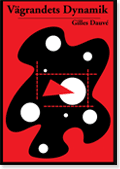
Vägrandets dynamik (The Tension of Refusal) is a book about communism and the communist movement. The book consists of nineteen provocative texts written by Gilles Dauvé between the years 1968 and 2003. The texts criticise capitalism, democracy and the moral order. They also examine where the foundations of insurrection and revolutionary activity exist today.
|
|
|
|
|
|





